
7 Ways to Get the Best ROI from Your People Development Budget

Investing in your people is essential for growth, but simply spending money on training won’t guarantee results. To truly get the most out of your budget and to ensure participants retain knowledge through experience, your culture must actively support learning by creating space for innovation, experimentation, and even failure. When your team feels empowered to try new things, reflect on what they’re learning, and continuously improve, the impact of your investment will increase exponentially.
Here are the top seven things you can do to maximize the return on your people development budget.
1. Align individual and team development with your organization’s purpose, core values, and goals.
To see a strong return on investment (ROI), your people development efforts must directly reflect your organization's purpose and values while supporting business objectives and the professional development goals of your employees. Development programs should move your organization forward and help individuals grow in ways that benefit everyone personally and collectively.
Ask Yourself
Do our professional development initiatives align with our purpose, values, and goals, as well as each individual’s growth aspirations?
Take Action
❏ Identify your organization’s top priorities and select development programs that align with both organizational goals and individual growth objectives.
❏ Have one-on-one conversations with team members to understand their professional development goals and link them to your broader organization objectives.
❏ Customize leadership training to address specific organizational challenges while empowering individuals to grow in areas they are passionate about.
2. Foster a culture of learning and experimentation.
Maximizing your people development budget happens when employees are continuously learning, innovating, and feeling supported to try new things — even if those ideas don’t always work out. Encouraging experimentation and treating mistakes as learning opportunities can transform your organization’s speed of growth.
Ask Yourself
Are we creating opportunities for teams to innovate, experiment, and learn from failure?
Take Action
❏ Encourage teams to test new ideas without fear of failure.
❏ Provide time and space for teams to reflect on what they’ve learned from both successes and setbacks.
❏ Create small, low-risk experiments that allow teams to apply new skills and approaches.
3. Invest in leadership development at all levels.
Leadership development isn’t just for your top leaders or new managers. By nurturing leadership skills across your organization — from individual contributors to senior executives — you strengthen your team overall, leading to better decision-making and more effective teamwork everywhere. What we've seen in our work with organizations of all sizes is that when people across an organization use a shared framework and common language, collaboration and communication become much simpler.
Ask Yourself
Are we investing in leadership development at all levels of our organization?
Take Action
❏ Offer leadership development opportunities for everyone, not just your senior team.
❏ Create mentorship and coaching programs to help emerging leaders grow.
❏ Ensure systems are in place to provide regular feedback and development plans that help everyone continuously improve.
4. Prioritize communication and collaboration skills.
High-performing teams rely on clear communication and strong collaboration. Investing in the development of these skills can drastically improve how your teams work together, solve problems, and execute projects. With our clients, we’ve seen how enhancing communication skills can resolve long-term or embedded challenges, such as cross-functional misalignment or ineffective decision-making. By fostering open, structured conversations, teams end up addressing underlying issues, building trust, and creating more sustainable solutions.
Ask Yourself
Are we providing our teams with the skills they need to communicate and collaborate effectively?
Take Action
❏ Offer programs that focus on improving communication both within and across teams.
❏ Create opportunities for teams to collaborate on cross-functional projects.
❏ Model transparency and encourage regular feedback to help teams work more cohesively.
5. Make learning interactive and applied.
The most effective learning is interactive and immediately applicable. Simply attending a workshop or training won’t yield strong results — participants must practice what they’ve learned. Prioritize development programs that include hands-on learning, team activities, and real-world applications.
Ask Yourself
Are our development programs providing practical, actionable tools that our people can immediately apply?
TAKE ACTION
❏ Choose programs that emphasize interactive and experiential learning.
❏ Invest in coaching for key leaders to support their practice and application of new skills on the job.
❏ Follow up on training with regular check-ins to see how knowledge is being used.
6. Measure the impact and follow up.
To truly understand the ROI of your people development spending, you need to measure its impact. This means setting clear goals for your programs, tracking progress, and following up to see how learning is being applied and impacting your organization.
Ask Yourself
Are we measuring the success of our professional development initiatives and adapting them based on what we’re learning?
Take Action
❏ Set specific, measurable goals for each professional development program.
❏ Implement feedback loops to gather insights from participants on what they’re learning.
❏ Regularly review how knowledge is being applied and driving results.
7. Create ongoing development opportunities.
One-time training programs often lead to brief periods of short-term results. To get the most out of investing in your people, it’s important to offer continuous learning opportunities, keeping your team engaged and growing over time. Ongoing development helps teams stay engaged and more effectively adapt to change.
Ask Yourself
Are we embedding continuous learning into our culture?
Take Action
❏ Create a development plan that includes regular opportunities for your whole team to learn throughout the year.
❏ Offer a variety of programs, for example — workshops, coaching, peer learning circles, mentorship programs.
❏ Champion learning in your culture as part of the everyday experience, not just a one-off event.
Committed to getting the most out of your development initiatives but not sure where to start?
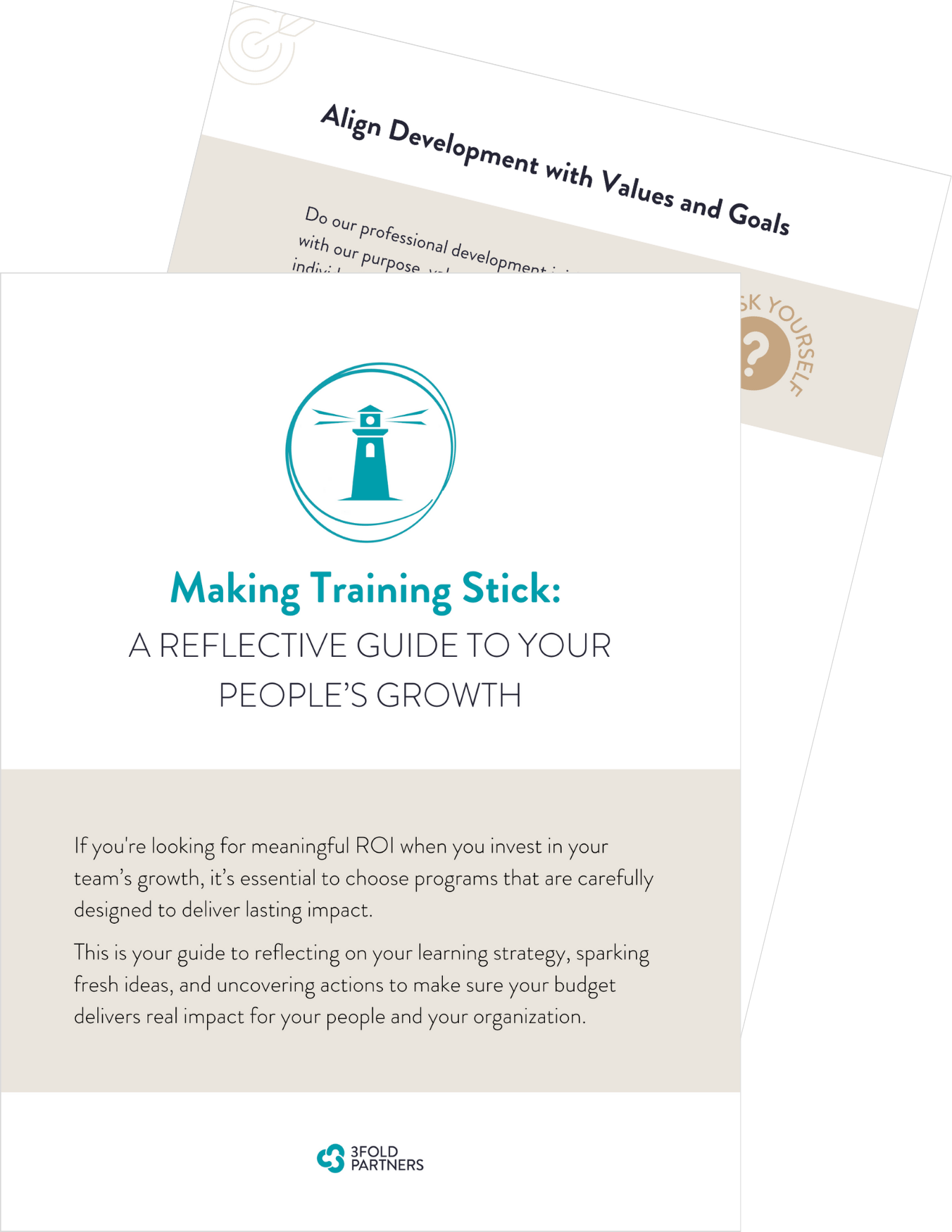
Download Making Training Stick: A Reflective Guide to Your People’s Growth to uncover the best place to begin.
How We Can Help
At 3fold, we help organizations turn people development into lasting results. Our programs are designed to support all seven strategies outlined above, tailoring solutions to meet your unique challenges and opportunities.
We’ve partnered with leaders to retain their top talent, helping them build engagement and create clear development paths. Today, these leaders are more connected, their teams more invested, and their organizations more resilient.
If the questions in this article felt tough to answer, we can help you navigate them. Let’s find your starting point and design a plan that works.
We focus on:
Cultivating leadership at all levels through emotional intelligence, mindfulness, and actionable practice
Facilitating hands-on learning that drives collaboration and innovation
Measuring impact with feedback and program assessments